Professional Restaurant Menu Design That Works
A well-designed food menu does more than list dishes—it sets the tone for the entire dining experience. The Food Menu template is a clean, modern, and professional layout crafted specifically for restaurants, cafés, catering businesses, grill bars, and hospitality brands that want to present their offerings with clarity and style. Whether you're running a neighborhood bistro or launching a new resort dining concept, this template gives you a polished foundation without the overhead of hiring a designer from scratch.
What Makes This Menu Template Stand Out
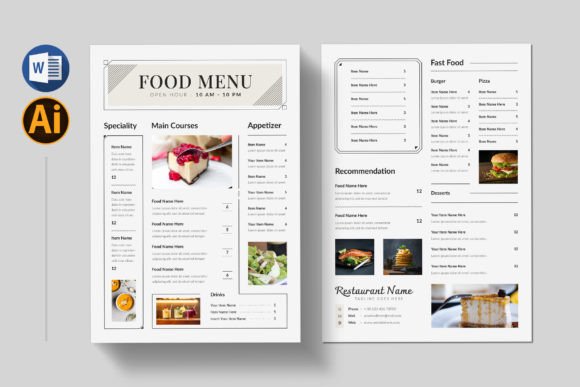
The visual personality of this Food Menu template leans into minimalism. It avoids clutter, relying on generous white space, balanced typography, and a structured grid to guide the reader's eye naturally from section to section. The layout feels contemporary—clean lines, well-organized content blocks, and a restrained color palette that lets the food descriptions take center stage. It doesn't shout; it invites.
That restraint is intentional. A minimal food menu template like this one works across a surprisingly wide range of dining concepts. A high-end seafood restaurant can use it just as effectively as a casual brunch spot or a corporate catering company. The design adapts because it doesn't impose a heavy stylistic identity—it provides a framework that your own branding can layer on top of.
Every element is editable. Colors, text, logos, and images can all be swapped out in either Adobe Illustrator or Microsoft Word, which means you're not locked into a single aesthetic. If your brand uses warm earth tones, adjust the palette. If your restaurant identity leans toward bold and modern, the template's structure supports that shift without breaking the layout.
Designed for Real Business Needs
This isn't a decorative mockup that looks great in a portfolio but falls apart in production. The Food Menu template is built for actual use. It ships at 8.75"×11.25" with a 0.25-inch bleed setting, uses CMYK color at 300 DPI, and comes in print-ready format. That means you can hand the file off to a print shop and get professional results without reformatting or troubleshooting resolution issues.
For small business owners—restaurant managers, café operators, food truck entrepreneurs—this matters. You need design assets that save time, not create more work. The included Illustrator (.AI and .EPS) and Word files cover both professional and accessible workflows. If you're comfortable with Illustrator, you get full control over every vector element. If Word is your tool of choice, the template is structured so that edits stay clean and predictable.
The template also uses Google Fonts and free fonts, with font links included in the download. That's a practical detail worth noting: you won't need to purchase additional typefaces to match the original design. For anyone managing a brand identity on a budget, keeping licensing simple and costs low is a real advantage.
Where This Template Fits Best
Think about the businesses that need a reliable, attractive menu: restaurants updating seasonal offerings, cafés refreshing their in-store materials, catering companies preparing client-facing documents, hotels designing room service menus, online resort shops creating downloadable PDFs. The Food Menu template serves all of these without feeling generic.
It also works well beyond the printed page. A web design team could adapt the layout for a restaurant website's menu section. A social media manager could pull elements from the template to create social media graphics promoting daily specials. A publisher producing a local dining guide might use the template's structure as a starting point for editorial menu features.
The key is understanding what the template does well: it provides a modern typography framework and visual hierarchy that makes menu content easy to scan. Diners don't read menus linearly—they scan for categories, prices, and familiar words. This layout respects that behavior with clear section headings, consistent spacing, and logical grouping.
Practical Tips for Getting the Most Out of It
Start by replacing the placeholder content with your actual menu items, but pay attention to the original layout's rhythm. The template's font pairing and spacing were chosen for a reason—to create a visual flow that feels effortless. If you swap typefaces, test your replacements at the actual print size. A display font that looks striking on screen might lose legibility at 12 points on a printed menu held at arm's length.
Keep your color edits aligned with your existing brand identity. If your restaurant already has a defined palette, apply it here. If you're still building your visual identity, the template's neutral default gives you room to experiment. Try two or three color variations and print test copies before committing.
For businesses that update menus frequently—seasonal restaurants, cafés with rotating specials—the Word file version is especially useful. You can make quick text edits without opening Illustrator, which keeps the process fast and accessible for staff members who aren't design professionals.
One important note: photos are not included, and mockups shown in previews are for demonstration only. You'll need to supply your own food photography. Investing in even a few well-lit, high-quality images of your signature dishes will elevate the final result significantly. The template's clean layout is designed to complement strong photography, not compete with it.
A Reliable Foundation for Professional Presentation
Good design doesn't need to be complicated. The Food Menu template proves that a well-organized, thoughtfully structured layout can serve a wide range of food and hospitality businesses with minimal fuss. It's a practical design asset—not a flashy one—and that's exactly the point. When your menu looks professional and reads clearly, customers notice. They trust the establishment a little more. They engage with the content instead of struggling through it.
For designers, marketers, and small business owners looking for a dependable menu template that balances creative font choices with real-world functionality, this one delivers. It respects both the print production process and the end reader's experience—and that combination is harder to find than it should be.